Legacy Images
What do you want your photographs to do?
Sell something. Save a moment. Show beauty. Announce who you are. Maybe, if you are feeling ambitious, nudge the world a little.
Or do you want something quieter. Do you want your pictures to last. Do you want them to become a kind of legacy, even if only a few people ever see them.
I repeat that word on purpose. “Legacy” has become a favorite question of speakers and planners. What legacy will you leave. A reputation. A nest egg. A name.
Photography has its own famous legacies, the kind we can picture without looking. In 1963, Malcolm Browne photographed the Buddhist monk Thích Quảng Đức during his self-immolation on a Saigon street, a still figure inside a moving wall of flame. Years later, Nick Ut photographed a terrified child, Phan Thị Kim Phúc, running from an attack, an image that has haunted the public conscience ever since. In 1968, Eddie Adams captured Nguyễn Văn Lém at the instant before his execution, the body and face tensing against what could not be stopped.
Those photographs matter. They also belong to a world most of us will never enter, and I am not writing about that kind of legacy. Think smaller.
Most of us will never be sent to a war zone with a deadline and a press pass. We will more often be sent to birthdays, backyards, and the grocery store parking lot. The world now makes something like 1.4 trillion photographs a year. Many will be made from a slightly higher angle, with a practiced smile, and a few will still turn out to be important.
Here is what I mean by a legacy photograph.
Years ago I made a simple portrait for a client. One person, one light, one dog, a few minutes. The man knelt beside his dog and the dog rested a paw on his knee, like a prom date who had decided to be loyal. We laughed at the silliness of it. I delivered the image and, as photographers do, moved on.
I forgot it completely until years later, when the man asked me to make it again.
By then, the first photograph had done something I did not know it could do. It had become a keepsake. Eight years after the shutter click, someone printed it large and placed it on an easel beside a casket. Inside the casket was the same man, a young father and husband, gone too soon, loved fiercely. In that goofy prom pose his friends and family could still see him, not as a subject, but as themselves. They could remember his humor, his gentleness, his particular way of being in the world.
His family did not know me. They would not recognize me in a lineup. That is part of what humbled me. I had made a photograph almost by accident, and it became a small bridge across a sudden absence. That is enough legacy for one lifetime.

If you need another example, I can supply two from my own drawer.
I have a photo of my grandfather holding a puppy somewhere overseas during the war. He looks stern, as he often did, but the puppy is doing its best to soften him. Some soldier pressed the shutter without any idea that, decades later, a grandson would treasure that picture.
I also have a photograph of my mother at about ten years old. She is healthy, bright, and strangely at ease, standing at the helm of a small ship as if the world has made room for her. Not long after, her life became complicated in ways no child deserves. I did not see that picture until after she died at fifty-six. It helped me meet her again, before illness and addiction took so much from her. The picture is my legacy, and mine alone, and I keep it private for reasons I cannot explain without making it smaller.
These experiences taught me that photographs do not need to be grand to matter. They do not need to change history. Sometimes they only need to return a loved one to the room, for a moment, and let someone smile through a lump in the throat.

The trouble is, you rarely know which photographs will do that. You cannot label them in advance. So take them now. Take many. Take the unposed ones. Take the pictures of people in their element, doing the ordinary things that will someday feel sacred.
I still carry a photograph I never made. My grandpa Ashdown in his garden, shovel in hand, cowboy hat on, busy and content. I meant to take it. I waited. Then he died, and the picture stayed in my head instead of in our hands.
That lesson stuck, so later my wife and I surprised my grandma Ashdown on her last day as a service missionary at the LDS Conference Center. We arranged for our whole family to be her final tour. She loved it. We loved it. We made photographs, because that is what you do when you finally learn.


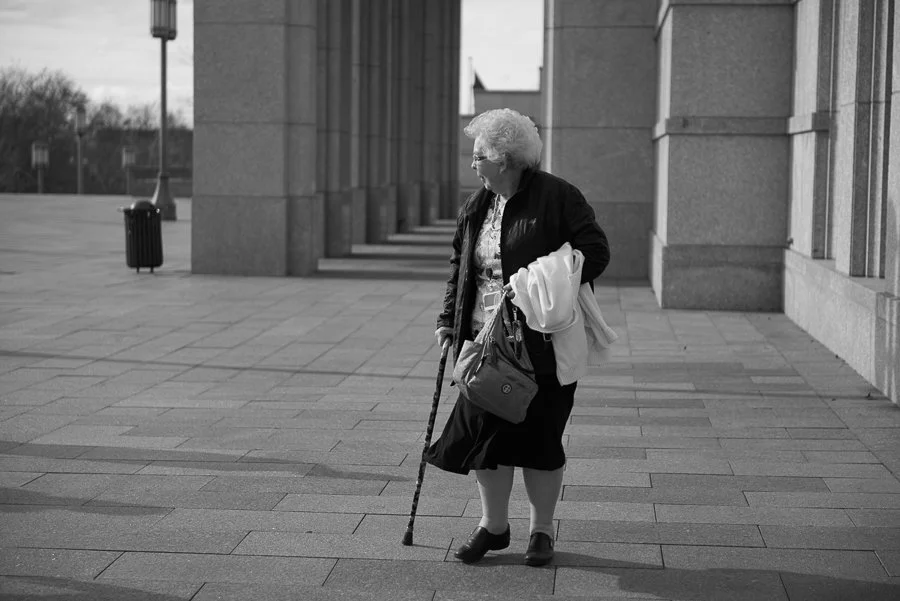
The last photo I took that day was of her walking back to turn in her identification card. She had forgotten it, and I asked her to go back because I wanted to catch the ending. Turning in the badge felt like a small ceremony. My grandma dislikes having her photo taken, and a little surprise was the only way we could pull it off.
She is a wonder, and a gentle soul. We are fortunate to still have her at ninety-three, and we hope to keep her as long as we can. The world will go a little darker without her.