Getting Dusted at White Pocket

For a long time I have wanted to visit White Pocket, Arizona. I can’t remember where I first heard the name, only that it lodged in my mind and stayed there, the way certain places do. It became a quiet bucket list item.
White Pocket has one practical problem. It is hard to reach. You need the right vehicle, the right road sense, and a willingness to accept that the desert does not care about your plans. My Kia Optima, dependable as it is, was not built for this. People get stuck out there. Getting unstuck can cost the kind of money that makes you sit very still afterward.
The inconvenience has an upside. Places that require effort tend to keep their dignity. White Pocket has not been loved to death.
While researching the area online, I found Dreamland Safari Tours and noticed they offered an overnight photography trip for $375. Transportation in and out, dinner, breakfast, snacks, and even tents and bedding were included. All you needed was camera gear and a toothbrush. After some scheduling, I booked April 19th and 20th.
We met at the Dreamland Safari Tours office in Kanab, where our guides, Sunny and Maddi, greeted us with the kind of calm confidence that immediately lowers your blood pressure. They loaded our gear, we climbed into the trucks, and we drove toward the sort of dirt road that makes you grateful someone else is holding the steering wheel.
I rode with Sunny, along with two younger travelers and a retired couple. Sunny talked as we went, explaining the terrain, pointing out signs of recent fire history, and telling stories about the region. She drove the long washboard stretches as if she had been born on them. I have driven plenty of dirt roads, but this one asked more than most vehicles can give.
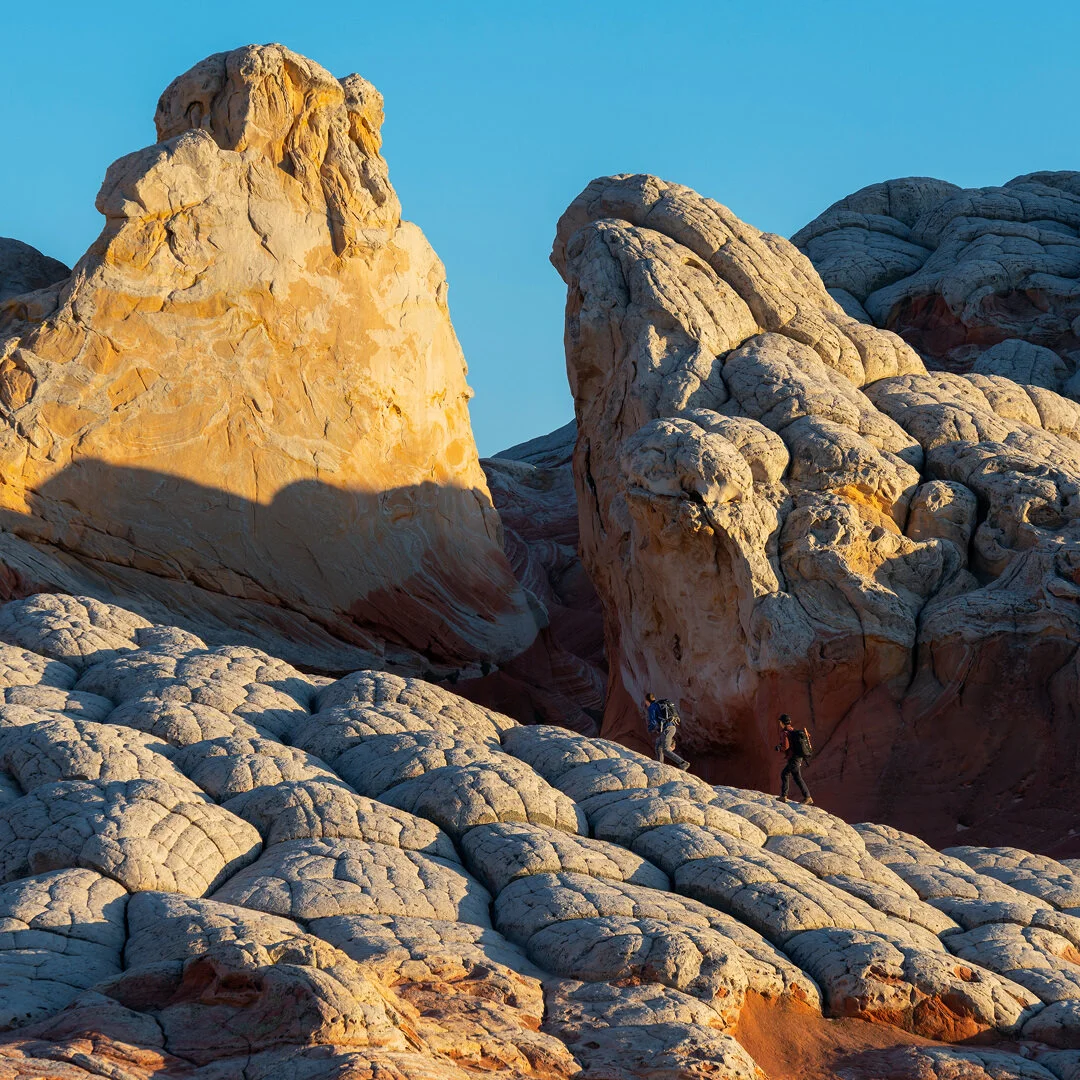
When we reached White Pocket, Sunny and Maddi set out chairs and a table so we could eat a snack and talk. Then Maddi led an orientation walk through the area, which was exactly what we needed. White Pocket is the kind of place that overwhelms a photographer. The options do not come in a line. They come in all directions at once. You can spend half an hour trying to decide where to begin, like standing in front of a shelf full of books you want to read at the same time.
During that first walk, the wind arrived with authority.
I can’t tell you its precise speed, but it was steady and strong, with gusts that felt intent on relocating us. The air was full of fine sand, the kind that finds every seam, every pocket, every eyelash. The odd part was how the wind behaved. It seemed to come from wherever it pleased, bouncing off rock and slipping through gaps, then changing its mind and arriving again from a new angle. At one point, believing the gusts had settled, I opened my camera bag at exactly the wrong moment and watched a sudden blast scatter sand across my gear like a practical joke.

Photographically, the first day was mostly a wash. Still, the place itself was a feast. The best description I can manage is this. Imagine a mile long pile of saltwater taffy, orange and cream, stretched and folded and twisted into swirls and alcoves. Now imagine it turned to stone. That is White Pocket, a candy dream that became geology.
Back at camp, Sunny and Maddi set up tents for ten people while wrestling the wind and sand. They cooked dinner, too, which felt like an act of competence bordering on heroism. I did not stay up long. I was tired and wanted an early start. I found my tent, brushed off a layer of sand from my sleeping bag and pillow, and tried to sleep. The wind howled for hours, the tent snapped and held, and eventually I did what the body does when it has had enough. I fell asleep. I woke around 5:00 a.m.
The morning had changed its mind.

When I stepped out of the tent, the wind was gone. The air was quiet. The stars were bright and close. I found my way through the dark to the rocks and began photographing. As sunrise approached, more people drifted in, everyone speaking softly as if we were in a cathedral. A few visitors used drones at times. Most people simply walked, looked, and tried to choose one composition out of a thousand.
I made a handful of images I would call “good,” and a few I would call “almost.” The sky was clear and simple, without much drama. Later, I replaced the sky in a couple of frames in Photoshop. I don’t do that often, but when a trip involves long miles and real expense, I don’t mind finishing an image if it helps me express what the scene felt like. I try to be honest about it, because once you replace a sky you have stepped into a different category. It is no longer only a photograph. It is a photograph plus a little construction, which is also a legitimate form of making, as long as you do not pretend otherwise.
After the sun cleared the horizon and the golden hour slipped away, I walked back to camp and ate breakfast. Not long after, we packed up, climbed back into the trucks, and headed for Kanab. The return trip felt longer, as return trips often do. Miles behave strangely on the way home. They stretch. Time does, too.

I can recommend Dreamland Safari Tours if you want an overnight to remote places like this. The experience was smooth, well cared for, and enjoyable enough that I have considered their Toroweap trip when I can make the schedule work. Toroweap, I am told, involves sixty-one miles of dirt road, some of it good, some of it not, and none of it something I want to attempt in a car.
Most of my photographs from White Pocket were fair rather than great. To show scale, I began including people in some frames, which helped. Even without a portfolio hero shot, I had a good time. I met friendly people, I saw a rare landscape, and I came home with sand in places I will probably never fully locate, which is one of the ways the desert signs its work.