Crashed at Beatty

“Next Gas 167 Miles”
Driving long stretches of road without another car in sight is one of my quiet talents. Something about wide land and empty pavement settles me. To end a whirlwind road trip, I took Highway 6 from Tonopah to Ely, Nevada, where a sign announces, with no sense of drama, “Next Gas 167 Miles.”
It is not exaggerating. There is no service between those towns. You do not drift that road by accident. It is remote, peaceful, and, in its own plain way, beautiful.
This trip began with an energy drink that ended up costing me $156 in Las Vegas. It included a friendly hotel in the middle of nowhere, a dark walk in Death Valley during a moonless night, a handful of ghost towns, and the most remote road I have driven in the lower forty eight. As usual, I told myself I was chasing light and photographs, and as usual the photographs were not the main thing in the end. I worked hard and came home with images I would call lackluster, but I cannot say I did not try.
I miss the brilliant image I am always after more often than I hit it. That is part of the bargain. Most trips end with a small pile of almosts, and a few lessons that only show up after a lot of thinking.
About a year ago I sold my Fuji X100F and bought an early copy of the X100V. I loved it, sold it, and regretted selling it for months. Some cameras come and go. Others stay with you. The X100 series has a way of getting under the skin. When I finally bought another, I decided to give it an opening run. I had time off, so I aimed for street photography in Las Vegas and sand dunes in Death Valley. Both plans failed, which is also a kind of success if you are honest about it.
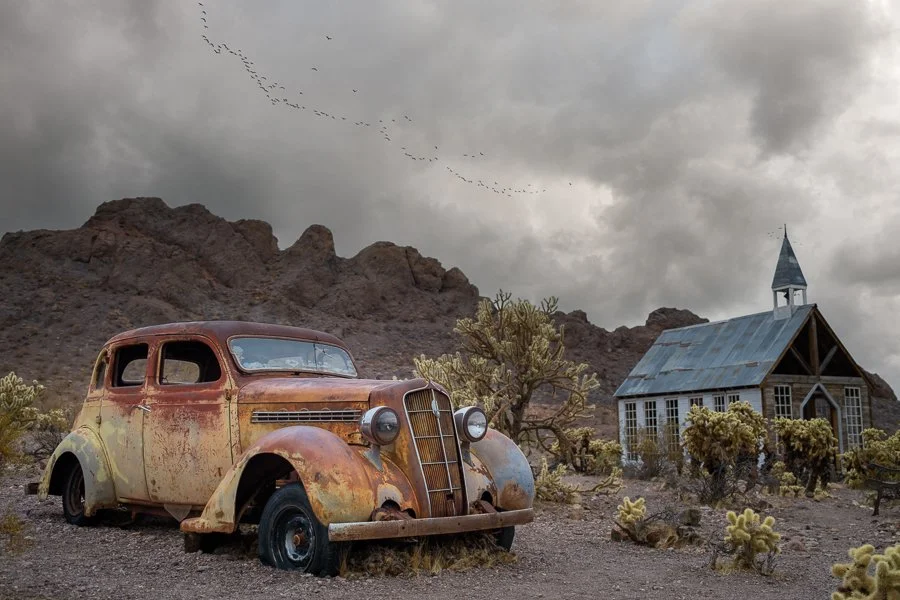
Las Vegas was technically open, but it felt strangely hollow. Crowds were thin, the air was gritty with a dust storm, and the usual street energy was missing. Instead of forcing it, I changed course and drove out to Nelson, a small mining town turned into a sort of living prop yard. I arrived with about thirty minutes of daylight left.

Nelson is a photographer’s playground. For a modest fee you can wander and photograph old cars, rusted signs, and scattered artifacts placed with the care of someone who understands what a camera likes. Wind made everything harder. It filled my mouth with grit and stole my hat more than once. Still, it gave me more to work with than the Strip did that day.
Back at Caesars Palace, I tried to prepare for a 4:00 a.m. departure toward Rhyolite and Death Valley. I also learned, the hard way, that the real cost of Las Vegas is often written in small print. My room rate was one thing. The resort fee was another. Then came the refrigerator.
The room had a fridge with a warning sticker that suggested it was not meant for ordinary human use. Inside was a tightly packed display of drinks and snacks. I placed one can of my own inside, thinking only of not drinking it warm the next morning. The following day, when I checked out, I found $154 in minibar charges tied to that decision.
The staff at the desk were polite and took my request to remove the charge. They explained that the fridge uses weight sensors. Move an item, add an item, disturb the balance of the universe, and it charges you. It was new to me, and oddly impressive in the way that over engineering can be impressive, like a watch that tells time on the moon. Still, it was a lesson. The desert will sandblast you for free. Las Vegas will do it by invoice.

I left the city in as much darkness as the Strip allows, and before long sagebrush and sky surrounded me. No people, no traffic, just road. My first stop was Rhyolite, a ghost town turned outdoor museum. As you arrive, one of the first sights is an art installation that resembles the Last Supper. The figures sit in place through sun and winter and years, which gives them a strange, watchful quality. I felt uneasy, whether from caffeine, solitude, or imagination, and did not linger.
I drove on into Death Valley, which I find plain in midday and magical in early and late light. The secret of the place is the way sunlight plays across simple geology. Separate, the elements are modest. Together, they become something else.

“Ghosts don’t haunt us. That’s not how it works. They’re present among us because we won’t let go of them.”
“I don’t believe in ghosts,” I said, faintly. Some people can’t see the color red. That doesn’t mean it isn’t there,” she replied.”
― Sue Grafton, M is for Malice


My destination was the Mesquite Flat Sand Dunes. They are easy to access, which is both their virtue and their problem. Many people walk them, and pristine dunes require effort and distance. I parked along the road a few miles away and approached from the side, hoping to reach clean sand before the light left.
The hike was peaceful. The day faded quickly. I had only a short window to photograph before the sun dropped out of reach. Instead of being angry about it, I stood there and looked. The silence was so complete I could hear my own heartbeat. It sounds like a line someone would write to make a moment feel important, but it happened, and it startled me.
I broke my usual rule and set up a quick self portrait. Then I walked back in deep dark across rocky ground, using a headlamp and a simple compass. I loved it. Not because it was dangerous, but because it required attention. The modern world asks for almost none.

My next hotel was an oasis called the Longstreet Hotel and Casino. After Las Vegas, it felt like a welcome mat. The staff were kind, the food was good, and they had gas at a reasonable price. That matters more than it should.

The next morning I drove home through Tonopah, Ely, and Wendover. The sign outside Tonopah repeated its warning about fuel, and it was correct. 167 miles with no service. On that road I saw wild donkeys and a few cars. About halfway I found an abandoned old hotel and casino, the sort of place that makes you slow down and imagine the lives that once passed through it.

I came home with no great photographs. I came home with a story, some quiet, and the feeling that the trip improved the moment Las Vegas fell behind me.
““To me, photography is an art of observation. It’s about finding something interesting an ordinary place… I’ve found it has little to do with the things you see and everything to do with the way you see them.”
— Elliott Erwitt”